Overview
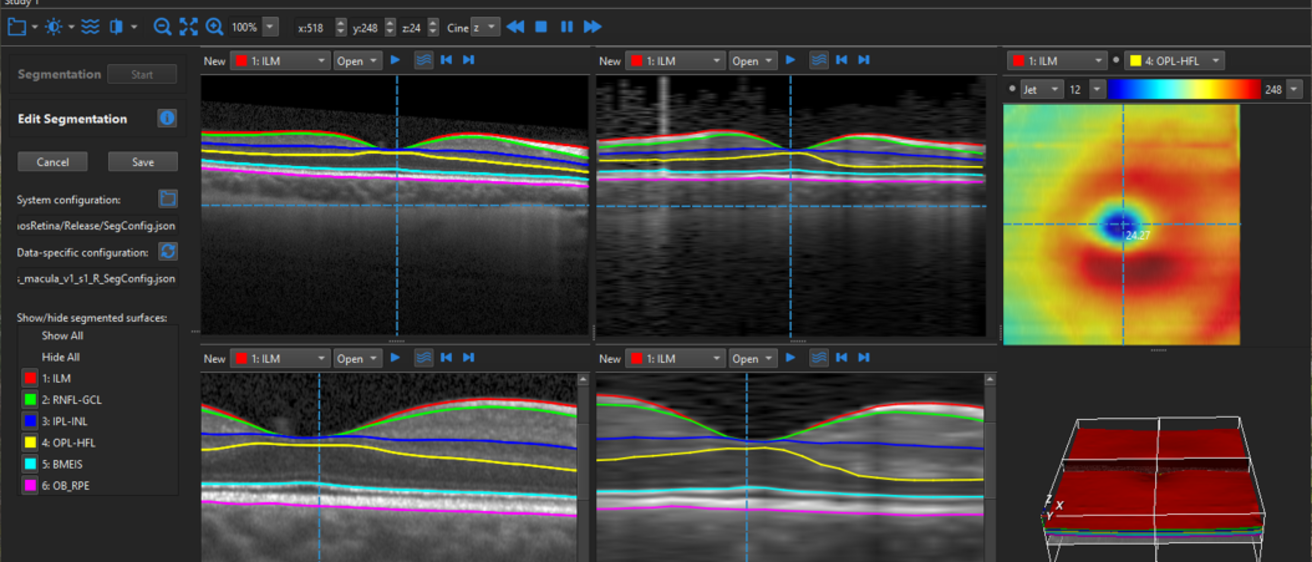
DeepLogismosRetina is the front-end application with graphical user interface (GUI) that performs 3D segmentation of retina surfaces in OCT (optical coherence tomography) images using Deep LOGISMOS (a hybrid of LOGISMOS and deep learning) segmentation method with built-in support of Just-Enough Interaction (JEI) that allows the user to edit automated Deep LOGISMOS results via intuitive and efficient interactions with the underlying algorithm.
DeepLogismosRetina is a completely new application that is different from OCTExplorer. The main purpose of OCTExplorer is to perform segmentation and additional analysis using limited number of pre-defined settings. DeepLogismosRetina aims to provide a open workflow that can be configured by the users to meet their specific requirements.
| Feature | DeepLogismosRetina | OCTExplorer |
|---|---|---|
| Input image format | ITK supported formats, e.g. NIfTI | Vender proprietary formats, e.g. *.vol |
| Output surface file format | Documented JSON and NIfTI | Undocumented custom XML |
| Additional analysis output | No | Undocumented various formats |
| Utilize deep learning results | Yes | No |
| LOGISMOS graph optimization | Multi-thread EIBFS | Single-thread Boykov-Kolmogorov |
| Number of surfaces to segment | Configurable | Fixed |
| Gradient based cost | Configurable | Fixed |
| Algorithm setting | Documented JSON configuration | Pre-tuned for typical macular and ONH |
| Editing segmentation errors | JEI modifies cost and maintain topology | Use splines to modify surface individually |
Because of the highly configurable nature of DeepLogismosRetina and its dependency on the quality of deep learning workflow (not provided) output, the configurations included in the downloadable examples are not the universally optimal settings that can achieve the best possible results on any OCT image.
Contents
The main download is DeepLogismosRetina.zip file for 64-bit Windows and it contains the following.
DataViewerLayer.exe: The data visualization application designed for visualization of 3D retina OCT (Optical Coherence Tomography) image and its segmentation represented as labels and surfaces.DeepLogismosRetina.exe: The main segmentation application that utilizes the data visualization capabilities implemented inDataViewerLayer.DataViewerLayer_Users_Guide.pdf: The document that describes the data visualization and user interaction features shared by both applications.DeepLogismosRetina_Users_Guide.pdf: The document focuses on the segmentation workflow, JEI features and detailed descriptions of configuration and output surface data file formats.- Other supporting files that enable portable applications such that the two executables can be run with any installation or administrator privilege.
In addition, ExampleData.zip is also available for download. It contains several example images, probability maps, configurations, and results.
Contact
- Regarding deep learning: zhi-chen@uiowa.edu
- Regarding user interface or LOGISMOS: honghai-zhang@uiowa.edu
License
DeepLogismosRetina is provided as is and can be used only for non-commercial research purposes.
Citing DeepLogismosRetina
- Please refer to the algorithm as
DeepLogismosRetina. - Acknowledge that the configurations are adjusted and tuned with respect to the specific characteristics of your own data.
- Cite some or all of the following papers that focus on different aspects of the algorithm.
- Hybrid Deep Logismos segmentation.
- The essentials of LOGISMOS and JEI.
- Incorporating in-region cost into LOGISMOS.
- Fundamental of LOGISMOS segmentation.
@Article{Chen2024,
  author = {Zhi Chen and Honghai Zhang and Edward F. Linton and Brett A. Johnson
and Yun Jae Choi and Mark J. Kupersmith and Milan Sonka and Mona K. Garvin and Randy
H. Kardon and Jui-Kai Wang},
  title = {Hybrid deep learning and optimal graph search method for optical
coherence tomography layer segmentation in diseases affecting the optic nerve},
  journal = {Biomed. Opt. Express},
  publisher = {Optica Publishing Group},
  year = {2024},
  volume = {15},
  number = {6},
  pages = {3681--3698},
  month = {Jun},
  url = {https://opg.optica.org/boe/abstract.cfm?URI=boe-15-6-3681},
  doi = {10.1364/BOE.516045},
}

@InCollection{Zhang2020JEIChapter,
  author    = {Honghai Zhang and Kyungmoo Lee and Zhi Chen and Satyananda Kashyap and Milan Sonka},
  booktitle = {Handbook of Medical Image Computing and Computer Assisted Intervention},
  publisher = {Academic Press},
  title     = {Chapter 11 - {LOGISMOS-JEI}: Segmentation using optimal graph search and just-enough interaction},
  year      = {2020},
  editor    = {S. Kevin Zhou and Daniel Rueckert and Gabor Fichtinger},
  isbn      = {978-0-12-816176-0},
  pages     = {249-272},
  series    = {The Elsevier and MICCAI Society Book Series},
  doi       = {10.1016/B978-0-12-816176-0.00016-8},
}

@Article{Garvin2009,
  author   = {M. K. Garvin and M. D. Abramoff and X. Wu and S. R. Russell and T. L. Burns and M. Sonka},
  title    = {Automated {3-D} Intraretinal Layer Segmentation of Macular Spectral-Domain Optical Coherence Tomography Images},
  journal  = {IEEE Transactions on Medical Imaging},
  year     = {2009},
  volume   = {28},
  number   = {9},
  pages    = {1436--1447},
}

@Article{Li2006,
  author  = {Li, Kang and Wu, Xiaodong and Chen, Danny Z and Sonka, Milan},
  journal = {IEEE Transactions on Pattern Analysis and Machine Intelligence},
  title   = {Optimal surface segmentation in volumetric images --- a graph-theoretic approach},
  year    = {2006},
  number  = {1},
  pages   = {119--134},
  volume  = {28},
}
Support
Development was supported, in part, by the following funding sources:
- VA-RR&D I50RX003002, I01RX003797, I01RX001786
- NIH-NIBIB EB044640
- NIH-NEI EY031544, EY023279, EY032522
Download
The University of Iowa is currently reviewing software download permissions. As a result, our software cannot be shared with anyone at this time.